How Does God Heal?
The interaction of love, medicine and miracles
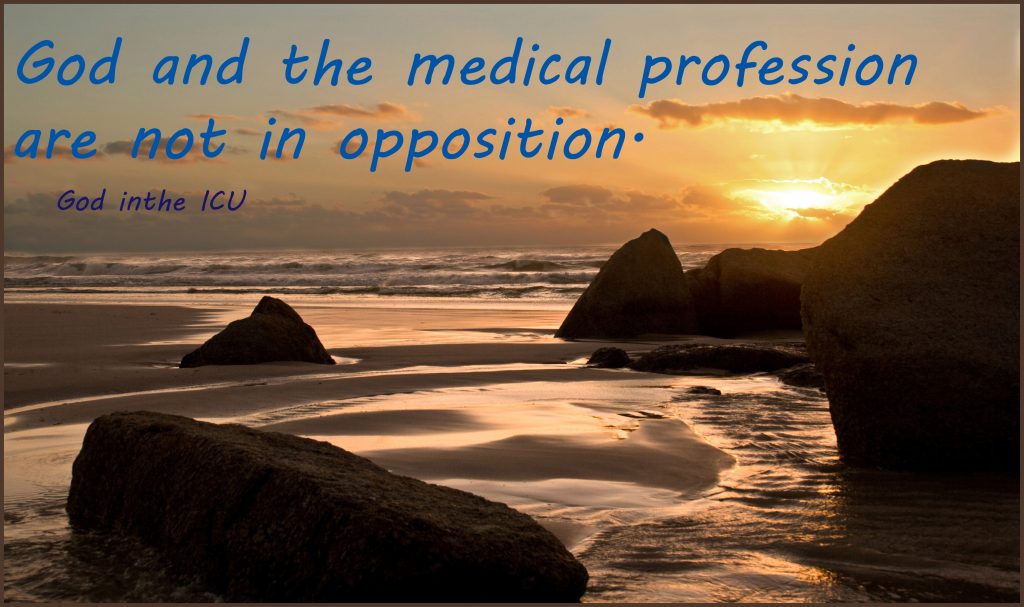
I suppose it’s because we can go to a doctor without any reference to God, that some people think of healing by doctors as some sort of alternative to God’s healing. I have heard people say, “I’m not going to a doctor. I’m trusting God to heal me.”
I’ve also heard others say, “Well, the doctor hasn’t done much, I’ll just have to pray.”
It’s as though doctors and God are in some kind of opposition.
The fact is, God is responsible for all true healing. As we walk in love, acknowledging His hand in our lives, we can participate with Him in our healing. An attitude of love, medicine and miracles are all part of God’s healing process. I write more extensively on this in Prayer, Medicine and Miracles, but want to write about it now because I’ve had direct experience of God intervening in my life through medicine.
My wife and I were due to go to a picturesque town in the Cape for a four month break house-sitting for my daughter. She hadn’t asked; it was an idea that came from nowhere as I awoke one morning, when I knew she’d be away.
Shortly before we were due to leave, I experienced a slight ache in my arm and a bit of breathlessness while jogging. Had we not been going to a fairly remote village, I probably would have ignored it, but because we would not be near sophisticated medical facilities, I thought I’d better get it checked.
Within a week, I was in hospital having a stent put into a major coronary artery which was close to blocking.
I have no doubt God put the idea of house-sitting in my mind to precipitate me into seeking a medical checkup for a minor complaint which, had I ignored it, could have killed me with a heart attack.
In His love, He used hi-tech medicine to fix my problem without major surgery.
- God deserves the glory for all true healing.
- When we see Him as responsible for all healing, we can avail ourselves of everything at our disposal
- This includes diet, exercise, alternative medicine as well, of course as prayer.
- In fact, prayer can enhance any other aspect of healing. In one instance which I describe in Prayer,Medicine and Miracles, I was asked to take over a patient in ICU who was deteriorating. I did not change any treatment, but started praying with him. He immediately improved and recovered.
- Of course, it doesn’t include methods that go against the Word of God (psychic healing, transcendental meditation or methods that pay homage to other religions). These might produce physical results but leave you spiritually oppressed/bankrupt, which is not true, holistic healing.
- Even if a doctor is not a believer, you can trust God to use him. There are instances in the Bible where God has used unbelievers for His purposes.
- It depends on where you put your focus. Keep your eyes fixed on Jesus and trust Him to heal you in whatever way He wishes (and He does wish it for you.)
- Nothing is impossible for God.
Heal me, O LORD, and I shall be healed; save me, and I shall be saved, for you are my praise. (Jer.17:14)